The Second Copernican Revolution: What Galileo Did to Geocentricity, Non-Dualism Does to Egocentricity.
In 1610, a restless Italian scientist pointed a crude telescope at Jupiter.
What Galileo Galilei saw changed humanity forever.
Through that narrow tube of glass, he discovered four small moons orbiting Jupiter. They did something shocking: they refused to orbit Earth.
This simple observation quietly shattered a worldview that had lasted thousands of years.
Until then, we believed in Geocentricity the idea that Earth sat proudly at the center of the universe while everything else circled around us.
Galileo’s moons told a different story.
Earth wasn’t the center.
It was just another participant in a much larger dance.
Humanity experienced its first great cosmic ego shock.
And yet, looking back, that moment didn’t shrink our world — it expanded it. Suddenly the universe was vast, alive, and full of possibility.
But something even more radical may be happening today.
The Next Revolution: From Egocentricity to Nondual Awareness
The Copernican revolution displaced Earth from the center of the cosmos.
The next revolution displaces something even closer:
the psychological center we call “me.”
What Galileo did to the solar system, nondual awareness does to the psyche.
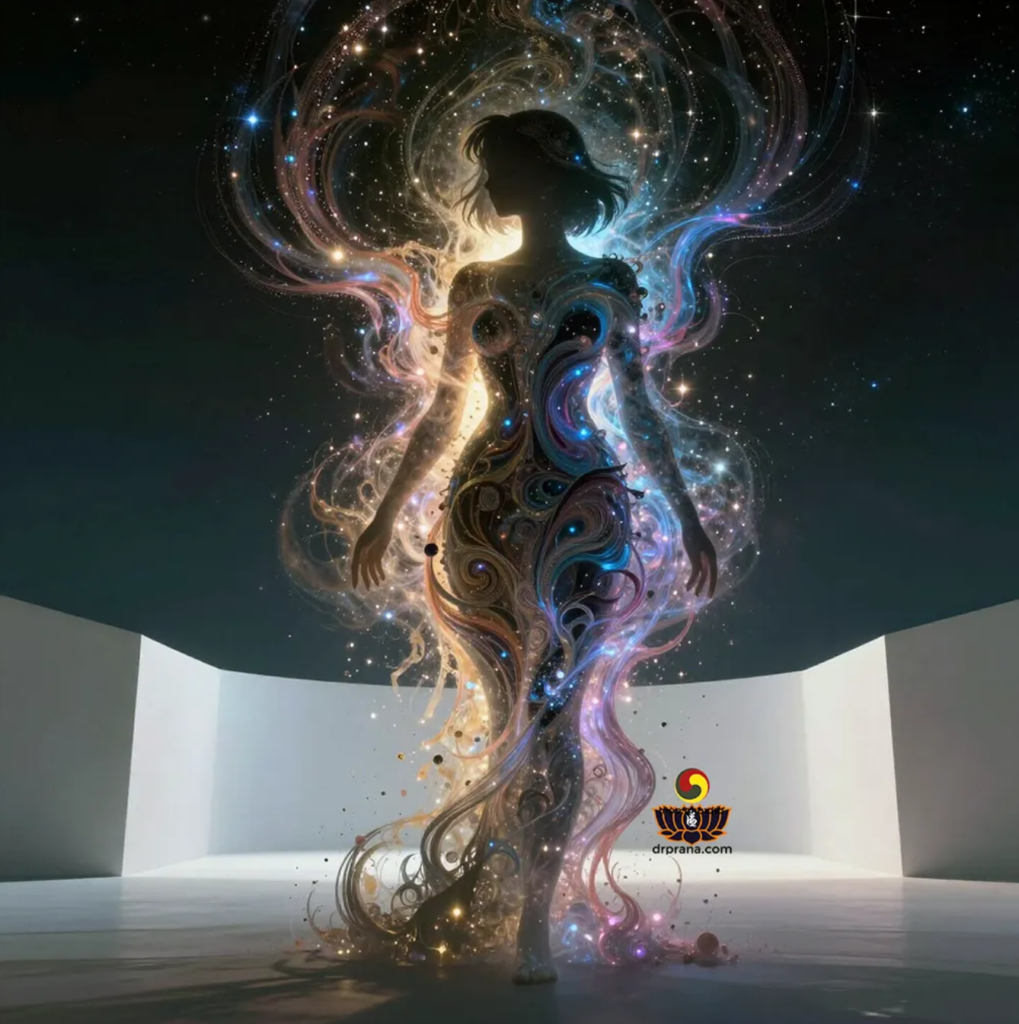
It reveals that the “I” we thought was the center of experience is not actually the center at all — it’s simply one movement within a much larger field of consciousness.
This idea appears clearly in the ancient Shiva Sutras, a foundational text of the Trika tradition (Kashmir Shaivism).
Its opening declaration is startling in its simplicity:
“Chaitanyam Ātmā.”
The Self is Consciousness.
Not the ego.
Not the personality.
Consciousness itself.
In this tradition, the sense of being a small, separate individual is called Āṇava Mala, the “impurity of smallness.”
It is the belief that we are a tiny point of identity inside a vast world.
But the Trika teachers say something extraordinary:
We are not the point.
We are the space in which the point appears.
Just as Galileo realized Earth was an object within a system rather than the system itself, these teachings suggest the ego is simply a localized movement inside universal consciousness.
When the Observer Becomes the Observed
Something remarkable happens when we begin exploring nondual awareness.
The sense of “I” slowly changes roles.
At first, the ego believes it is the observer, the one looking at the world.
But as awareness deepens, a quiet shift occurs.
The ego itself becomes something observed.
Thoughts arise.
Emotions move through.
Identity patterns appear and dissolve.
And something deeper is present through all of it.
Not a person.
Not a story.
But a luminous presence that simply knows.
In that moment we realize:
We aren’t the one looking at the world.
We are the light by which the world, and the ego itself, is seen.
The Daoist Perspective: The Strength of Softness
While the Trika tradition can feel like a lightning bolt of insight, Daoist wisdom offers another path.
A path of softness, water way.
Like rain wearing down a mountain.
The Tao Te Ching gently warns:
“The stiff and unbending is the disciple of death.”
Egocentric identity tends to be rigid.
It tries to hold a fixed position.
“I am this.”
“I must protect that.”
“I need to control this outcome.”
Daoism invites something very different.
The practice of Wu Wei, an effortless alignment with the flow of life.
Instead of trying to be the center around which life orbits, we begin to rest in what Daoists call the Valley Way.
The valley does not compete with the mountain.
It receives everything.
And because it is empty, it contains the whole landscape.
Today, this shift from egocentric thinking to nondual awareness is appearing not just in contemplative traditions, but in modern science.
One fascinating voice in this conversation is Federico Faggin, the engineer who helped create the first commercial microprocessor.
After decades in technology, Faggin reached a surprising conclusion.
Consciousness cannot be reduced to computation.
In his book Irreducible, he writes:
“The ‘I’ is not a machine… it is a localized expression of a universal field of qualia.”
In other words, the ego is not the creator of consciousness.
It is a temporary expression within it.
In a sense, science is building the telescope for our time, the instrument that may help reveal the deeper structure of mind itself.
Why This Shift Matters for Health and Well-Being
This shift is not just philosophical.
It has measurable effects on the body and nervous system.
Research into contemplative practices shows that nondual awareness can:
Quiet the Brain’s Ego Network
The Default Mode Network (DMN) — associated with rumination and self-referential thinking, becomes less active.
Less mental chatter.
Less anxiety about past and future.
Calm the Stress Response
The amygdala becomes less reactive, reducing chronic fight-or-flight activation.
Improve Vagal Tone
Higher heart rate variability (HRV) indicates stronger parasympathetic regulation — our body’s “rest and repair” mode.
Restore Energetic Balance
In Ayurveda, calming the mind pacifies Vata, the nervous system principle linked to anxiety, insomnia, and digestive disorders.
Settle the Spirit
In Chinese medicine, when the mind quiets, the Shen, the spirit of the heart, returns home.
The signs are simple but profound:
clear eyes, deep sleep, and a relaxed presence.
The Real Surprise
Many people fear that letting go of egocentricity will make life feel empty.
But the opposite happens.
When the ego stops trying to be the center of everything, life becomes larger.
Galileo didn’t destroy our world when he moved Earth from the center.
He revealed how vast our cosmic neighborhood really was.
Nondual awareness does the same thing for the psyche.
You don’t lose yourself.
You discover that you were never confined to the small self you thought you were.
A New Kind of Exploration
The Copernican revolution required telescopes.
The next revolution requires something much simpler.
Attention.
Curiosity.
And the willingness to explore awareness itself.
Over the past several years I have been exploring how ancient nondual traditions, somatic healing, and modern science converge around this shift from egocentricity to living awareness.
And the results are remarkable.
Less tension.
More clarity.
Greater resilience.
And a surprising sense of freedom in ordinary life.
An Invitation
If this idea resonates with you, the please reach out as I offer a small experiential group workshops exploring:
“Nondual Awareness for Health, Resilience, and Longevity.”
Together we’ll explore:
• simple practices to quiet the egoic mind
• how nondual awareness affects the nervous system
• somatic ways to access the “luminous space” within experience
• why ancient traditions and modern neuroscience are converging on the same insight
Because the next great revolution may not happen in the stars.
It may happen inside the way we experience ourselves.
And like Galileo’s discovery, it may reveal that the universe, and our own awareness, is far vast than we ever imagined.